
Anatomy of a Plinko board
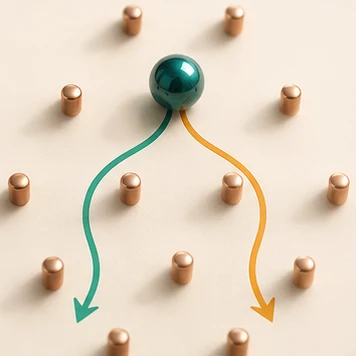
A peg is one of the small obstacles in the board. The pegs form staggered rows so the ball can move a step to either side. The bottom is divided into landing bins. In software the animation shows how the chosen sequence of steps leads to a bin.
On a simple model with N rows, there are N + 1 landing bins. The 12-row setting on our free simulator therefore draws 13 bins. On a physical Plinko machine, a release point, the board shape and the way the ball collides with real pegs can also affect the path.
How to play in three steps
- Check the rows and the printed payout table. Find a centre multiplier and the two outside multipliers.
- Choose the settings. A row setting can change the number of bins, while risk can change their values.
- Drop a ball. Read the landing bin, then distinguish a result below 1×, exactly 1× or above 1×.
On this site, the process is a practice exercise. For a version with a stake, the product’s paytable and rules determine the result and the real-money guide explains how it affects a cash balance.
Why the middle usually appears more often
Imagine four equal left-or-right steps. The far left takes four lefts. The centre can be reached by six different sequences with two lefts and two rights. Both can happen on a single drop, but the centre has more paths that reach it.
The same logic scales to our eight-, ten- and twelve-row simulator. One pattern is still required to reach each extreme. The steps on the previous ball do not change the possible sequences on the next one.
Can you control the ball?
The controls let you select settings before a drop. Standard digital Plinko does not ask you to steer the ball halfway through its descent. Before relying on a claimed strategy, check whether the feature actually changes game rules or merely changes what the animation looks like.
Multiple Plinko balls can make a streak look meaningful. If rounds are independent, a run of centre landings does not make the next ball more likely to reach the edge. Reducing the speed of a practice session can make it easier to read outcomes and compare settings.
Trace a path by counting moves to the right
Draw four small rows on paper. At every row write L or R for the move the ball makes. The sequence L, R, R, L contains two right moves. The sequence R, R, L, L also contains two. On the ideal board used in our practice game, those paths reach the same landing position. The final position depends on how many right moves the ball makes. The order determines its path through the display.
Five possible positions sit under a four-row model. Zero right moves puts a ball in the far-left bin. Four right moves puts it in the far-right bin. Going one step right and left for the other three rows lands one position in from the left. It can do that by making its right move at the first, second, third or fourth row. Four different sequences reach that bin even though each sequence is only one of sixteen possible patterns.
In the fair four-row model, the five probabilities from left to right are one, four, six, four and one out of sixteen. Mathematicians call this a binomial distribution when each step has the same independent chance of going right. You can draw it with a row of five bars. The bar at the centre is six times the height of either edge bar. This picture is a useful check that you have counted paths correctly.
Read the multiplier and the result separately
Every multiplier belongs to the bin directly above or beside it in the game interface. If you want to compare two board settings, record the numbers from left to right with the settings displayed. When the number of rows changes, use relative positions like centre, one left of centre and outside right. A bin with the same ordinal number can appear in a different position when the count is different.
Now imagine a made-up game using practice units. A stake of ten units reaches 0.7×. The gross return is seven and the net change after subtracting the stake is minus three. A separate ten-unit stake reaching 1× returns ten, for a net change of zero. At 1.6× the same stake would return sixteen and increase the hypothetical balance by six. These are constructed examples. The practice board does not take a stake or credit a balance.
When interpreting a paid game, look for terms like total payout, profit or payout excluding stake in its rules. The approach above uses a multiplier applied to a stake to calculate the gross return. The published definitions tell you what the figures on that particular screen represent. If multiple drops or an extra feature share a screen, check the amount debited alongside the amount returned before comparing outcomes.
Separate the number of rows from the selected risk
Rows describe the depth of the simple board. Add two rows and there are two additional bin positions. With fair steps, each of the two extra choices doubles the number of possible sequences. The absolute outside position still requires a sequence entirely to the same side. For example, moving from eight rows to ten changes the theoretical chance of one specified extreme from one in 256 to one in 1,024 in the fair-step model.
What the risk label changes
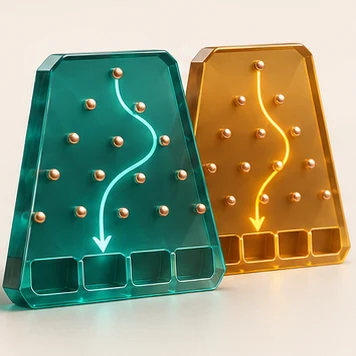
Risk labels describe the game’s settings for a round. On many boards the labels appear beside the row setting, which makes the controls seem interchangeable. On the site’s practice board, picking a risk level changes the numbers assigned to positions. Picking a row count changes the number of positions and the paths that can reach them. A named provider may define its controls differently, so check the individual help file when going beyond the practice model.
How to isolate the difference
Compare settings in two steps. First hold the rows fixed, change the risk and note differences between centre and edge values. Then choose one risk, change the number of rows and count the bins. This is easier to follow than changing both settings and making a drop immediately. You can run both comparisons on the free Plinko demo. When the result appears, check the highlighted bin as well as the number. Neighbouring bins can display the same rounded multiplier.
Calculate an average without guessing the next drop
This four-row example uses five landing bins and sixteen equally likely paths. For each group, multiply the number of paths by the sample multiplier to get its contribution to the overall return.
| Landing group | Paths | Multiplier | Gross return |
|---|---|---|---|
| Two outside bins | 2 | 4× | 8 units |
| Two adjacent bins | 8 | 1× | 8 units |
| Centre bin | 6 | 0.5× | 3 units |
| Total | 16 | — | 19 units |
The total return in that counting exercise is nineteen units across sixteen equally likely paths, or an average of 1.1875 units. Changing the two outside multipliers to 2× gives fifteen units in total and an average of 0.9375. These numbers are made up to illustrate how much the average depends on which values belong to which probabilities. They are neither values from the site simulator nor a description of a casino game.
An average describes a mathematical model over repeated trials. Individual results can sit far above or below it. If you complete one short set of drops, there is no reason for your observed average to equal the model’s figure. The important habit is to read the chances and the paytable together when both are available. The biggest label, the average return and the chance of a result above 1× are different quantities.
Keep the animation in its place
The downward motion helps you follow the choices, but a game can display a path at a different speed without changing the result model. In the simulator on this site, each step is chosen in the browser and used to draw the movement. The result is still shown when reduced motion is enabled. The time you spend watching the ball differs, while the number of left-or-right opportunities stays the same.
On a physical display, a board and its ball have measurable dimensions, and the details of the release and collisions matter. The fair-step calculation used here deliberately removes those details. It models a ball as making an independent left-or-right choice at each row. Use that assumption when reading the example. It can illustrate why middle bins often appear without telling you exactly how an unrelated physical machine or online product behaves.
If you are checking a video of a supposed pattern, ask the person to specify the game and its settings before giving the prediction. Then write down which drop they intend to forecast, including the landing bin, before it happens. A description offered after a result can fit many different paths. In the independent model there is no special position that a previous miss makes more likely on the next drop. This is one reason to treat the animation as a way to understand a result already produced.
Common questions
What does a Plinko ball land in?
It lands in a bin at the bottom of the board. The bin’s value is the round’s score or multiplier under that version’s rules.
Do more rows improve the odds of a win?
More rows change the possible routes and bins. The rules, probabilities and paytable together decide the chance of a result above 1×.
What is the difference between a board and a Plinko machine?
The board is the peg layout. A physical machine includes the board and its housing or release system. A digital game simulates the layout.
Sources

New Zealand SEO and copywriting consultant.